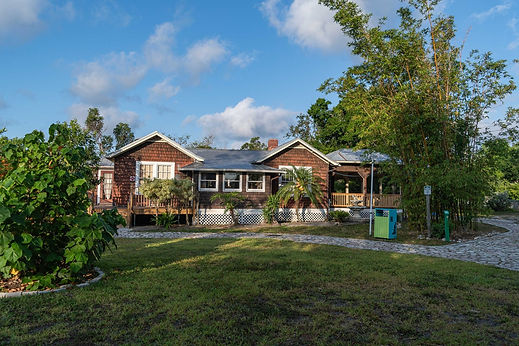
Price House (c.1914):
The Price House originated as two small cottages on Gilchrist Street, constructed before 1914. Their side-by-side layouts were documented on the city's Sanborn Insurance map, and their footprints still match today's house—except for the added side porch.
On November 25, 1915, the Punta Gorda Herald announced that Mr. and Mrs. Benjamin D. Price had arrived from Atlantic Highlands, New Jersey. Although this was their sixth winter spent in Florida, it was the first time they chose Punta Gorda. Benjamin Detwiler Price, an architect, was famous for designing churches sold by mail order and had also designed Philadelphia's first steel-framed skyscraper. Between 1867 and 1910, his firm sold over 7,000 plan sets, including one sent to Punta Gorda—the old Methodist Church (now New Life in Christ) on Marion Avenue is built from his Perspective #220 design.
The Prices returned the following two winters with their niece, Mary Jackson Price, a talented architectural draftsman and house designer—a rare profession for women at the time. When they came back in October 1918, the Herald published a detailed article about them. After selling their farm in New Jersey, the family settled permanently in Punta Gorda, joined by Mary J. and their son Max, who was also an architect. Benjamin had retired, leaving Max and Mary J. to run the family business.
They purchased the two cottages on Gilchrist Street, plus an adjacent carriage house. The small homes were joined by a central parlor and a porch, and the carriage house became a workspace. Cedar shake siding unified the exteriors, giving the buildings a classic look typical of coastal homes along the Eastern Seaboard. The family resided there for several years.
Max Charles Price became involved in local government, serving as Mayor in 1921 when Charlotte County was established, and Punta Gorda was named the county seat. He later resigned to be the first City Manager, while Mary J., a committed suffragette, continued overseeing the design firm.
Benjamin Price passed away in 1922, followed by Mary D. in 1946, and Max and Mary J. in 1948. All are buried together at Indian Spring Cemetery. The distinguished red brick church on Marion Avenue still stands, and many churches Benjamin designed nationwide as now featured on the National Register of Historic Places. Locally, two buildings designed by Max remain: Villa Bianca, a Mediterranean Revival riverfront mansion in Solana (also on the National Register), and the former County stockade on Florida Street, currently used for storage.
Over time, the Gilchrist Street property changed owners several times. The Searles family bought it in the 1990s, turning it into a Bed & Breakfast, then sold it in 2003 to Juergen Sieure, who was unaware of its history. In January 2004, Sieure applied for a demolition permit intending to construct four bungalows. Public outcry prompted him to reconsider and ultimately donate the buildings to the Punta Gorda Historical Society, allowing fundraising for relocation.
By August, preparations for moving the buildings were underway, but Hurricane Charley struck on August 13, heavily damaging History Park and destroying the carriage house. Despite setbacks, the Society persevered; on February 16, 2005, the three parts of the Price House arrived at History Park, were reassembled, and restoration began. Moving the buildings cost $80,000.
Today, the Price House serves as the home for the Peace River Woodturners, who use the space as a workshop, classroom, and gallery showcasing beautifully crafted wooden art.